
Container desiccant
GRF Protect strips
A calcium chloride desiccant built for shipping containers. It absorbs moisture from the air and holds it as a gel inside the sachet, helping keep the container dry through the transit it was sized for.
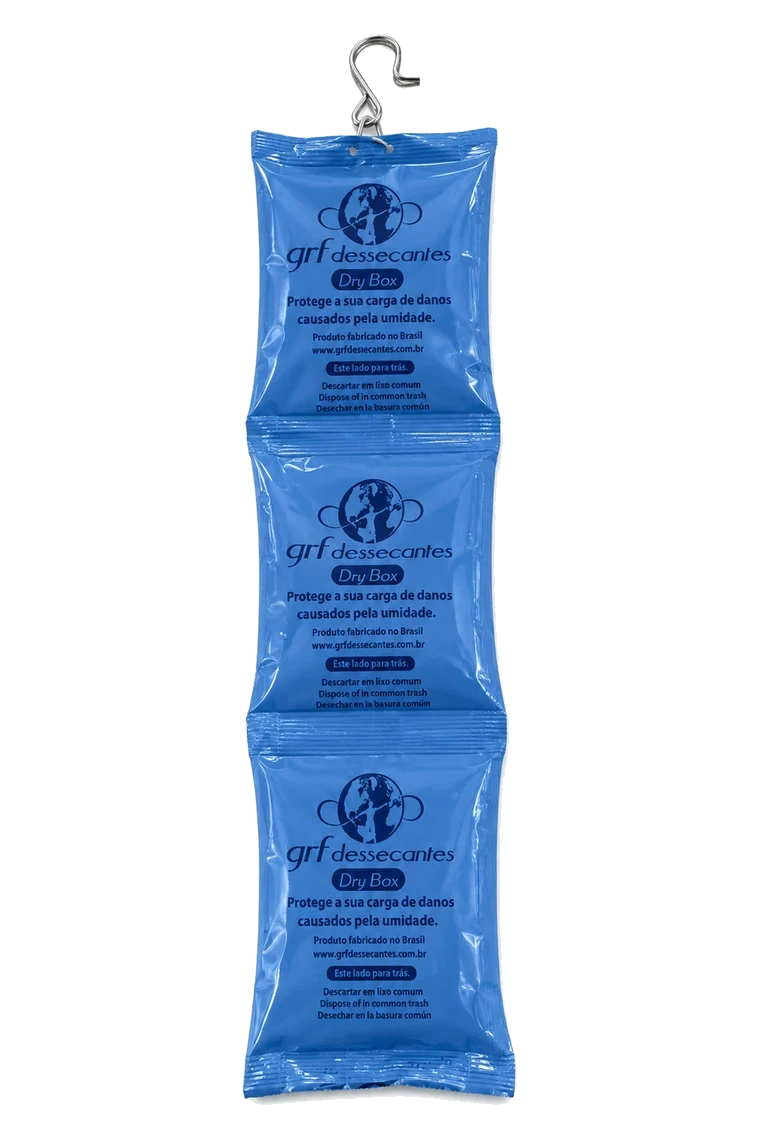
125 g
per sachet, strips of 3, 6 or custom
How it works
Absorption by deliquescence. Held as a gel.
Calcium chloride captures water vapor from the air and dissolves in the water it absorbs, forming a solution. A starch-based gelling agent holds that solution inside the sachet as a gel.
The result: less condensation on the walls and ceiling, which means less mold, corrosion and deformed packaging on arrival.
Data sheet
Product specifications
- Composition
- Calcium chloride (CaCl₂) with a starch-based gelling agent
- Physical form
- Granular
- Odor
- Odorless
- Residual moisture at 284 °F (140 °C)
- Maximum 3%
- Absorption starts at
- About 29–31% relative humidity, at 68–77 °F (20–25 °C)
- Usual application
- Confined spaces above 40% relative humidity
- Operating temperature
- Ambient
- Storage
- Original sealed packaging, in a dry place
Source: Technical Data Sheet FT-DRYBOX-125, rev. 04 (November 2026). Full document on request.
Supply
Available configurations
- Sachet
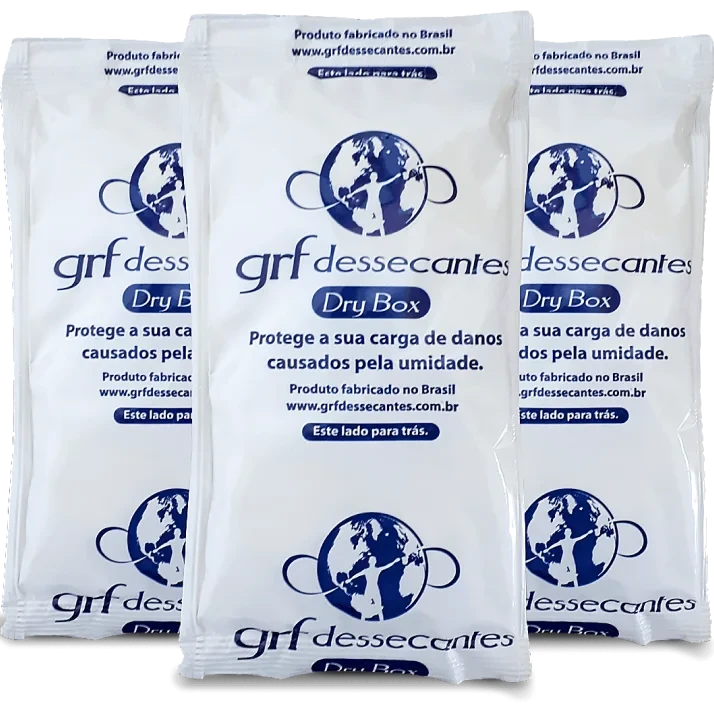
- 125 g (4.4 oz), non-woven wrapper with polymer layer
- Strips
- Strip of 3 sachets, 375 g (13.2 oz), and strip of 6 sachets, 750 g (26.5 oz)
- Custom
- Strips with other numbers of sachets, made to your order
- Box
- 72 sachets: 24 strips of 3 or 12 strips of 6, 19.8 lb (9 kg) net
- Box size
- 11 × 11 × 11 in (28 × 28 × 28 cm), 22 lb (10 kg) gross
- Mounting
- Hook, to hang on the wall, or self-adhesive, to attach directly to the surface
- Versions
- Non-woven sachet and a double-enclosure version
Strip, mounting and box configuration are adapted to each operation.
Best practices
Correct use, inspection and replacement
Size it first
Correct sizing depends on air volume, container tightness, dwell time and door openings. Ask for the sizing plan before the first shipment.
Keep it off sensitive surfaces
The retained solution is saline. Do not place sachets directly on sensitive metal surfaces or on electrical and electronic equipment.
One set per shipment
Hang the strips before the doors close and remove them at destination. For long-term storage, follow the inspection schedule in your sizing plan.
Keep sachets sealed
Handle strips by the outer packaging and do not open, cut or pierce the sachets. Keep them away from direct contact with food and animal feed. Store unused strips in the original sealed packaging, in a dry place.
FAQ
Product questions
What is the difference between a calcium chloride desiccant and silica gel?
Silica gel works by adsorption: it has a finite number of adsorption sites and therefore a capacity limited by the material itself. Calcium chloride captures moisture by deliquescence, and a starch-based gelling agent holds the resulting solution inside the sachet as a gel.
How much desiccant should I use per container?
It depends on the container air volume, its tightness, the transit time, how often the doors are opened and the cargo. Send us your route, transit time and cargo type and we return a written sizing plan, free of charge.
How long does it last? Can it be reused?
Each set is used for one shipment: hang the strips before the doors close and remove them at destination. Your sizing plan sets the quantity to cover the full transit, and adds strips for longer transits or for storage at destination. The strips are single-use.
Is it safe to handle? How do I dispose of it?
Handle the strips by the outer packaging and keep the sachets closed: if a sachet is opened, the granules can irritate the eyes. Keep sachets out of reach of children and animals and away from food and animal feed. Dispose of used sachets closed, according to your local regulations.
Free sizing plan
Know how many you need.
Every route is different. Send the details and get a written plan with quantity, placement and inspection schedule.