Absorb
The desiccant granules capture water vapor from the container air and absorb up to 300% of their own weight.

Container desiccants
When the temperature drops during the voyage, the water vapor in the air sealed in your container can condense on the ceiling and walls and drip onto the cargo. GRF Protect strips pull that moisture out of the air and hold it as a gel, helping reduce condensation and moisture damage to your cargo.
The problem
A sealed container is a closed box of air that rides through day and night, ports and oceans. When the temperature drops, at night or in colder waters, that air releases its moisture as droplets on the ceiling and walls, which then fall. Shippers call it container rain.
The water comes from inside: the humid air at loading, the wooden pallets, the cartons and the cargo itself. Scroll to watch it happen.
Illustration · values are indicative
01 · Loading
Humid air, wooden pallets, cartons and the cargo itself all carry water. The doors close and that moisture travels with your goods.
02 · Night at sea
At night, or in colder waters, the ceiling and walls get colder than the dew point of the air inside. Water condenses on them, the way a cold glass sweats on a hot day.
03 · Container rain
Droplets grow on the ceiling and fall onto the load. Mold, rust, soaked cartons and peeling labels show up at the destination.
04 · GRF Protect
GRF Protect absorbs water vapor from the air and holds it inside the sachet as a gel, so there is less moisture left to condense.
How GRF Protect works
The desiccant granules capture water vapor from the container air and absorb up to 300% of their own weight.
The absorbed water turns into a solution that a starch-based gelling agent holds inside the sachet as a gel.
With less vapor in the air, less water condenses on the ceiling and walls. Less mold, rust and soaked cartons at the destination.
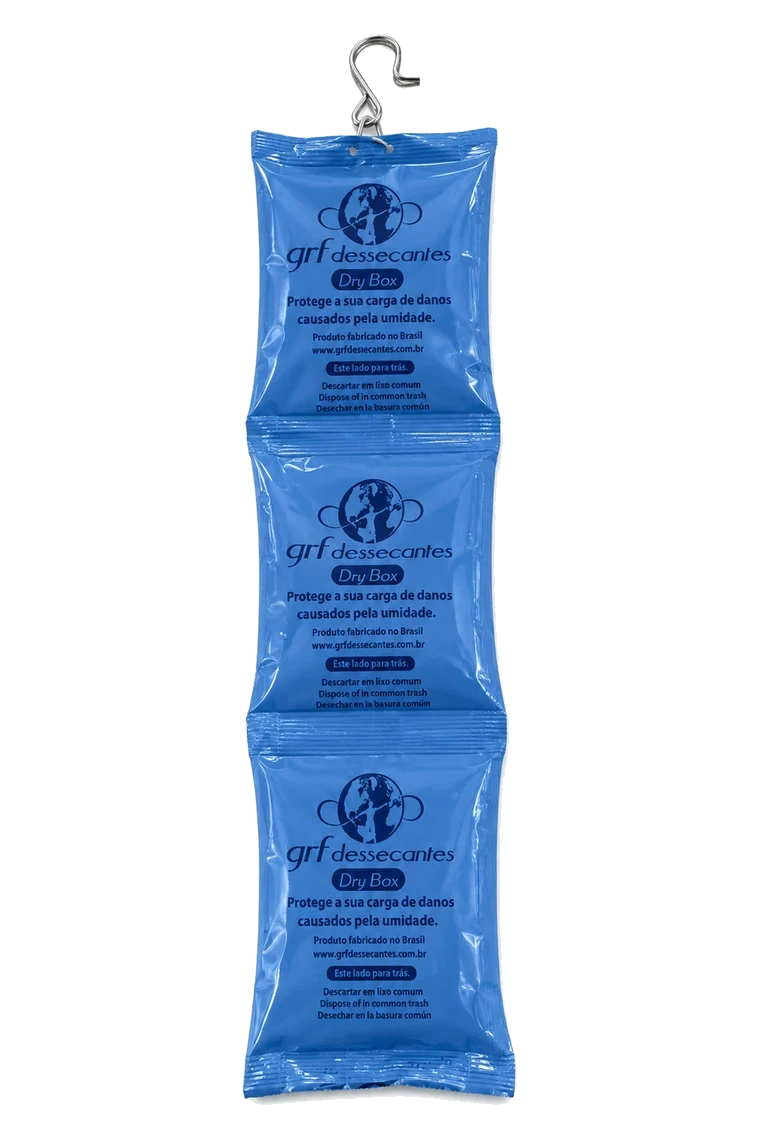
125 g sachets
strips of 3, 6 or custom
The product
125 g sachets joined in strips of 3 or 6, or in the count your operation needs, with a hook to hang on the container wall or a self-adhesive backing. Sized for 20-ft, 40-ft and 40-ft high cube containers and for long transits.
Who uses it
Try it
Dew point of the air inside
77°F
Condensation likely
The roof gets colder than the dew point. Droplets will form on the ceiling and can drip onto the cargo.
Free sizing plan
We size your operation before you buy. You get the plan in writing, whether you order from us or not.
Start my planFAQ
It depends on the cargo, the route, the transit time and how tight the container is. Send us those details and we return a written sizing plan with the quantity, placement and inspection schedule. It is free and carries no purchase obligation.
It captures water vapor from the air inside the container and holds it inside the sachet as a gel. With less water vapor in the air, less of it condenses on the cold ceiling and walls.
On the container walls. Strips come with a hook, to hang on the wall, or with a self-adhesive backing, to attach directly to the surface. Do not place sachets directly on sensitive metal surfaces or on electrical and electronic equipment. Keep the sachets closed and away from direct contact with food.
One set protects one shipment. Your sizing plan calculates the quantity for the full transit, and adds strips for longer transits or for storage at destination. The strips are single-use.
In Brazil, by GRF, which has manufactured container desiccants since 2014. Ask us about delivery to your location when you request your sizing plan.
Free sizing plan
Tell us your cargo, route and transit time. We send back a written plan: how many strips, where to hang them and when to check them. Free, no purchase required.